
About the project
The architecture of postmodernism and Polish transformation…
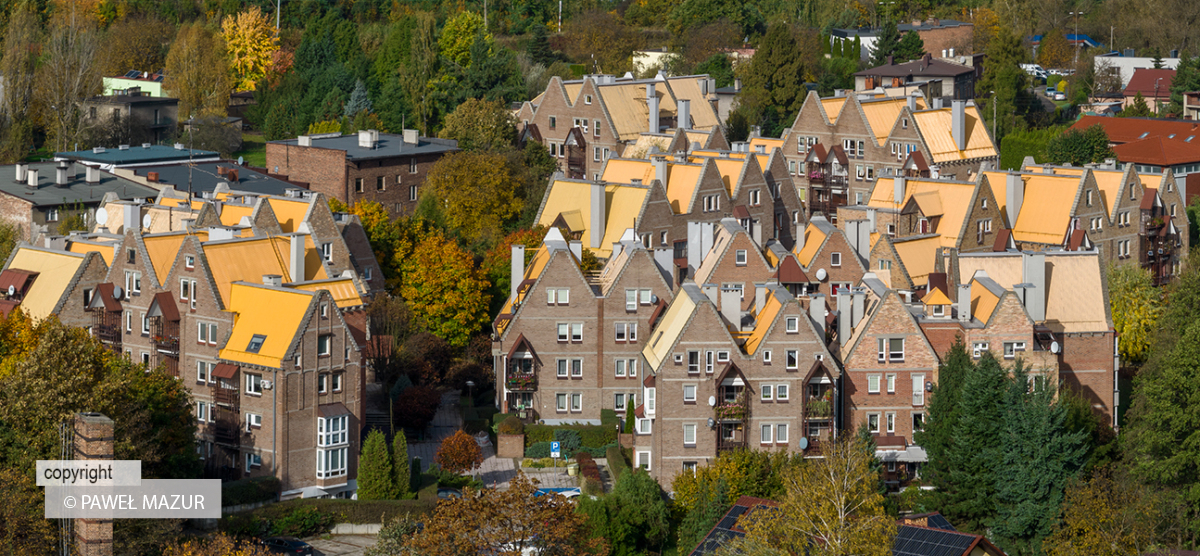
…does not inspire widespread admiration, and the intensifying process of its demolition does not provoke particularly dramatic protests. Rather, it provokes ironic smirks, embarrassment and consternation. The vast majority of people associate it with kitsch, tackiness and trash. Examples of it that have become somewhat ingrained in the collective consciousness, such as Solpol, which is no longer there, and Curtis Plaza, which is now falling into dust, shone and spoke for a moment because they were funeral speeches-memes.
The demolition of the former gave rise to the viral declaration ‘I didn’t cry for Solpol’, because when it was still standing, it was ‘Frankenstein on Świdnicka Street’, ‘a building that no one loved’ and, in many other ways, the quintessence of ugliness and aesthetic disaster.
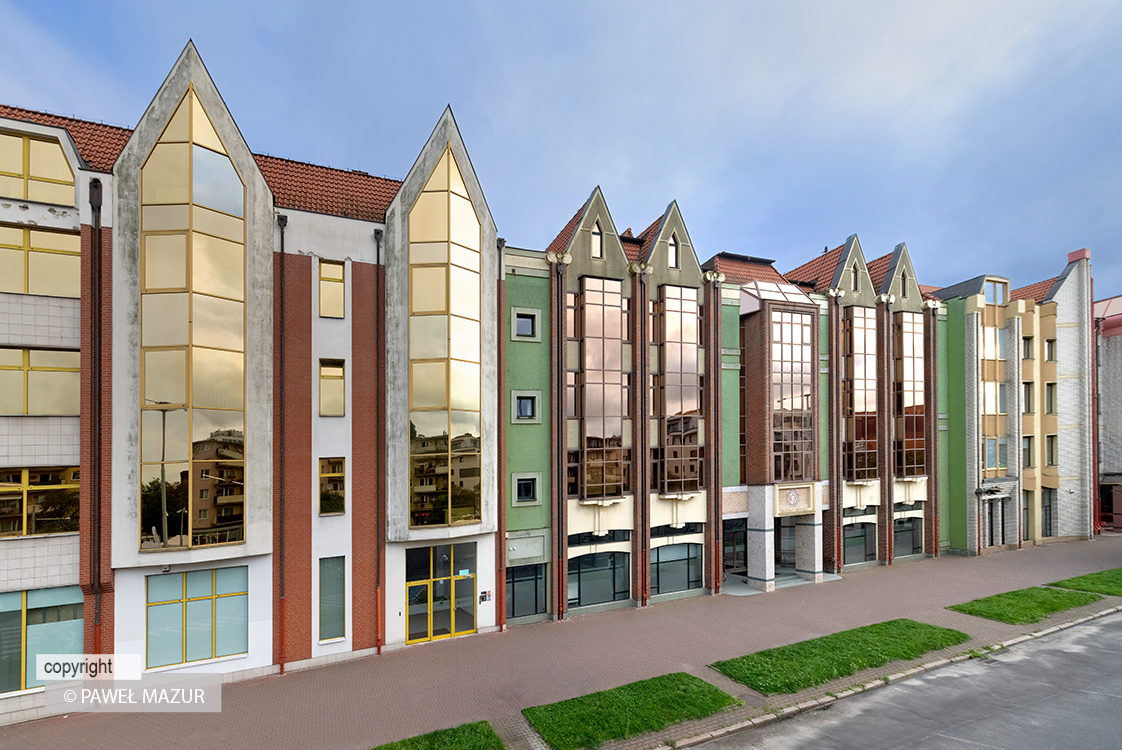
Bulldozers are already heading for their next targets: the railway station in Częstochowa, Złote Kamienice in Gdańsk (the headquarters of the infamous Amber Gold), Intraco, several office buildings in ‘Mordor’ and a whole series of supermarkets and shopping centres in many large cities in Poland. Here and there, the process of analysis, assessment and opinion polling is underway, which – unless it is met with public protest – will quickly lead to the demolition of more troublesome buildings (Atol in Augustów, Alma in Krakow). The justification for this nationwide demolition is always the same: the unprofitability of renovation and technical difficulties in adapting the buildings to current standards. Less officially, there is a widespread and fairly universal problem with the aesthetics of a generation ago.
But… postmodernism is also doing well.
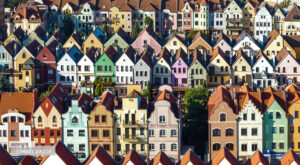
Probably best on Włókiennicza Street in Łódź.
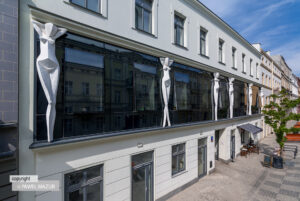
For over a decade, as if outside of time in a parallel, shifted reality, post-postmodern tenement houses have been tirelessly constructed here. With panache, seriously, in large numbers. When in Łódź, it is worth visiting Włókiennicza Street and discovering the brand new façades of historic tenement houses, surprising with their post-postmodernist and transformative spirit. This is part of the Łódź City Centre Revitalisation Project, worth almost PLN 300 million, under the supervision of the city architect, with slight embarrassment on the part of the authors, who consistently refuse to reveal their names. Fans of the era of cigarettes and the Polonez Caro may like it, but critics write about ‘the last reserve of postmodernism’ (A&B).
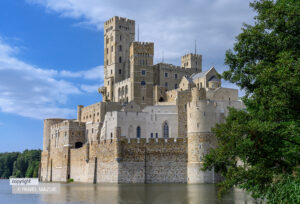
However, Łódź is not the only place drawing on tradition. In Stobnica, construction has been underway for a decade on the largest Polish “Gargamel” of all time, a 70-metre castle on an artificial lake. In Tychy, one of Stanisław Niemczyk’s last and most unique works has been under construction for 25 years – the stone Church of St. Francis of Assisi and St. Clare, which is still missing its fifth, 70-metre tower. The expansion of Elbląg’s old town, which began in the 1980s using the retroversion method, which involves rebuilding historic architecture while preserving the street plan and quarters in a new, postmodern form, is still ongoing. Following recent changes to the local spatial development plan of the Kartuzy municipality, the would-be national Hogwarts – Łapalice Castle, the largest (5,000 sq m) and longest-built Polish unauthorised construction (1983) – will be completed and legalised.
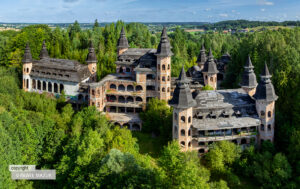
So, while the architecture of postmodernism and transformation may not inspire excessive sympathy, it is difficult not to notice that we have quite a lot of it and that it is still being built. It varies – some of it is bad, some bland, and some outstanding. The process of demolishing or taming it (with paint, polystyrene and a hammer) is ongoing. The first popular and academic publications have also appeared, attempting to demystify it, treat it seriously, and present it in the context of social and political history and the development of architecture. Perhaps the moment we are in is quite well reflected in the mood of one of the online comments in the discussion about the demolition of Solpol, which someone considered to be ‘the ugliest, but one we will miss’. Its schizophrenic tone will accompany us as we begin our search for postmodern and transformational objects on the Polish Internet. We will find them quite easily and in large numbers on lists, compilations and online forums such as
‘The 10 ugliest buildings in Poland’,
which, with a great deal of mockery and malice, grill architectural kitsch, but also – as if by momentum – a large number of good projects from the 1980s and 1990s.
The precursor to this game was most likely the now defunct website whyart.pl, where in 2013 a text by a certain ‘Cassidy’ appeared under the title ‘The 10 Ugliest Polish Churches – A Subjective Review of Sacred Architecture’. In the following years, the list was copied in whole or in part and the idea was developed by almost all major newspapers and portals, as well as dozens of local websites (Wyborcza, WP, SE, Onet, Interia and others). Currently, there are dozens of such clickbait productions on the internet, in which almost 100% of the buildings are postmodern or were built during the Polish transformation. The largest social networking site is not far behind, where we can learn from profiles such as ‘Churches that pretend to be chickens’ (over 51,000 followers) or ‘The bishop cried when he consecrated’ (21,000).
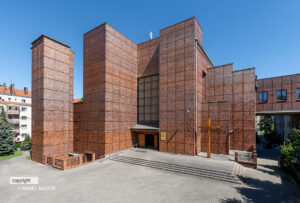
Rankings of ‘monstrosities’ often include buildings that also appear on lists of icons and architectural gems. A frequent favourite in ranking counterproposals is, for example, the Church of St. Stanislaus Kostka in Wrocław, designed by Stefan Müller, which, according to some, beautifully combines ‘modernity with the achievements of the past’, and, according to malcontents, ‘looks like a whole block of flats’ with a figure of ‘Christ preparing for a suicidal leap’. A popular subject of letters of shame is the Church of the Redeemer of the World in Wrocław, built according to a very good, competition-winning design by Jadwiga Grabowska-Hawrylak, or – as many believe – the most beautiful Polish ‘ZUS palace’ in Jelenia Góra by Leopold Chyczewski.
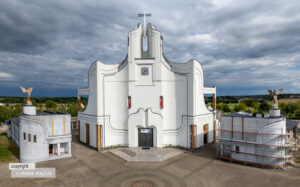
Internet mockery has its echoes and consequences in real life. In 2020, the Church of Our Lady of Perpetual Help in Grajewo (one of the most frequently mocked churches in Poland) was carried out, during which a dozen-tonne openwork tower designed – like the entire temple – by Prof. Tadeusz Zipsera, ‘an architect obsessed with wavy lines’, was removed. The owners of the Sobieski Hotel in Warsaw also succumbed to pressure, changing the colour scheme of the façade from postmodern ‘lingerie pastels’ to elegant shades of white and grey. In such circumstances, the case of Warsaw’s V-Tower (Warta Tower) seems extremely positive, as its new owners, despite the temptation to demolish the late 20th-century building (a completely new construction is often cheaper), opted for its revitalisation and modernisation, which will preserve its shape and appearance.
The project ‘Architecture of Transformation and Postmodernism in Poland (postmodernism.eu)’ presents photographs taken between March and November 2025 and shows the current state of nearly two hundred buildings constructed between the 1980s and the end of the first decade of the 21st century. It covers postmodernism in the final years of the Polish People’s Republic, its transformative faces in the two subsequent decades of the emerging free market in Poland, and the accompanying folk, private and amateur construction initiatives. It is not limited to icons and recognised examples; it includes stylistically ambiguous buildings and sometimes – mainly due to long investment or design periods – goes beyond the period 1980-2010.
© All rights reserved, Paweł Mazur
Contact: pawel@bankfoto.info, mobile 501160901