
Warsaw, Supreme Court
2026-02-04
The design for the complex at Krasiński Square in Warsaw was selected in a competition held in 1991. The winning concept was created by Marek Budzyński and Zbigniew Badowski, with around 20 other architects collaborating. As Budzyński recalled on Polish Radio Program 2, the competition was organized by the Warsaw City Architect together with the President of the Supreme Court, and “the whole operation was initiated by a Polish businessman from the USA, who promised to build the Supreme Court if he received 30 percent of the building.” When it turned out he was a fraud, who also wanted to buy the Palace of Culture and Science, the idea of building a new Supreme Court was abandoned for several years. The impasse was only broken by an agreement between President Adam Strzembosz and Prime Minister Włodzimierz Cimoszewicz, as a result of which construction began in 1996 and was completed three years later.
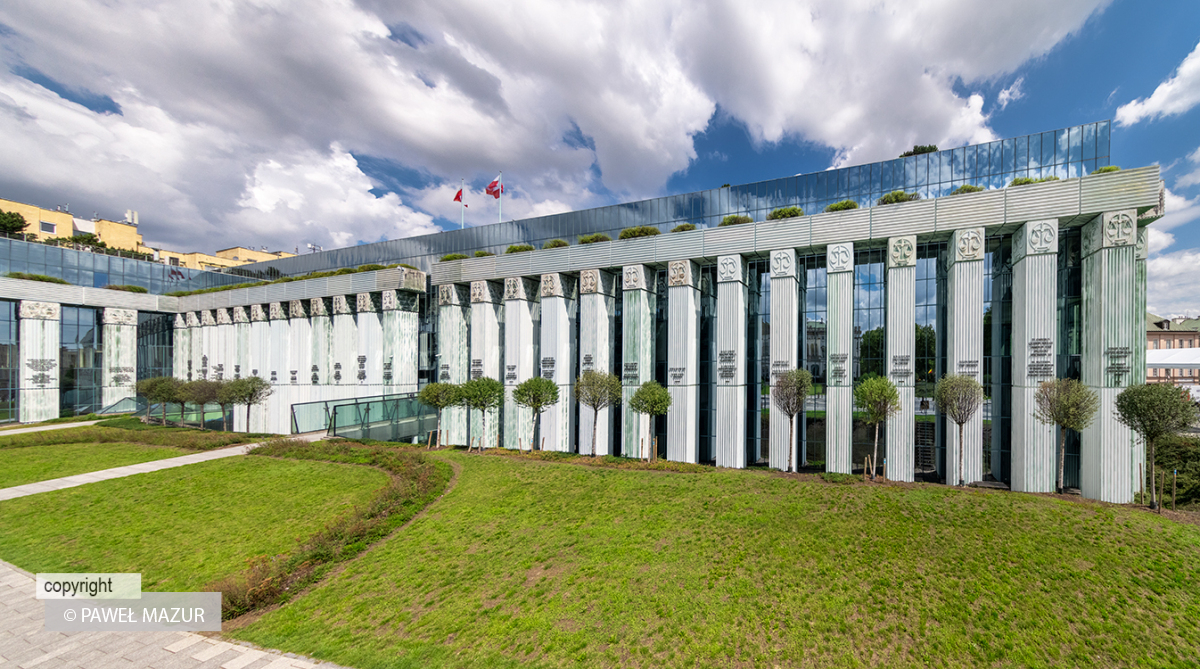
The designers of the country’s most important courthouse aimed to “illustrate the role of law in human life,” which gave rise to the idea of 76 “columns of law” with short sentences presenting fundamental legal principles. For example, the first column facing the Krasiński Palace displays the statement “Anyone who, while holding a public office, accepts money from interested parties commits extortion” (in Polish and Latin).
The building, commonly known as the Supreme Court (formally the Urban Justice Complex), also houses the Warsaw Court of Appeal and a branch of the Institute of National Remembrance. In the alcove in the building’s northern corner stand three caryatids (architectural supports in the form of women) by Jerzy Juczkowicz, symbolizing faith, hope, and love. Address: 2/4/6 Krasiński Square, Warsaw.